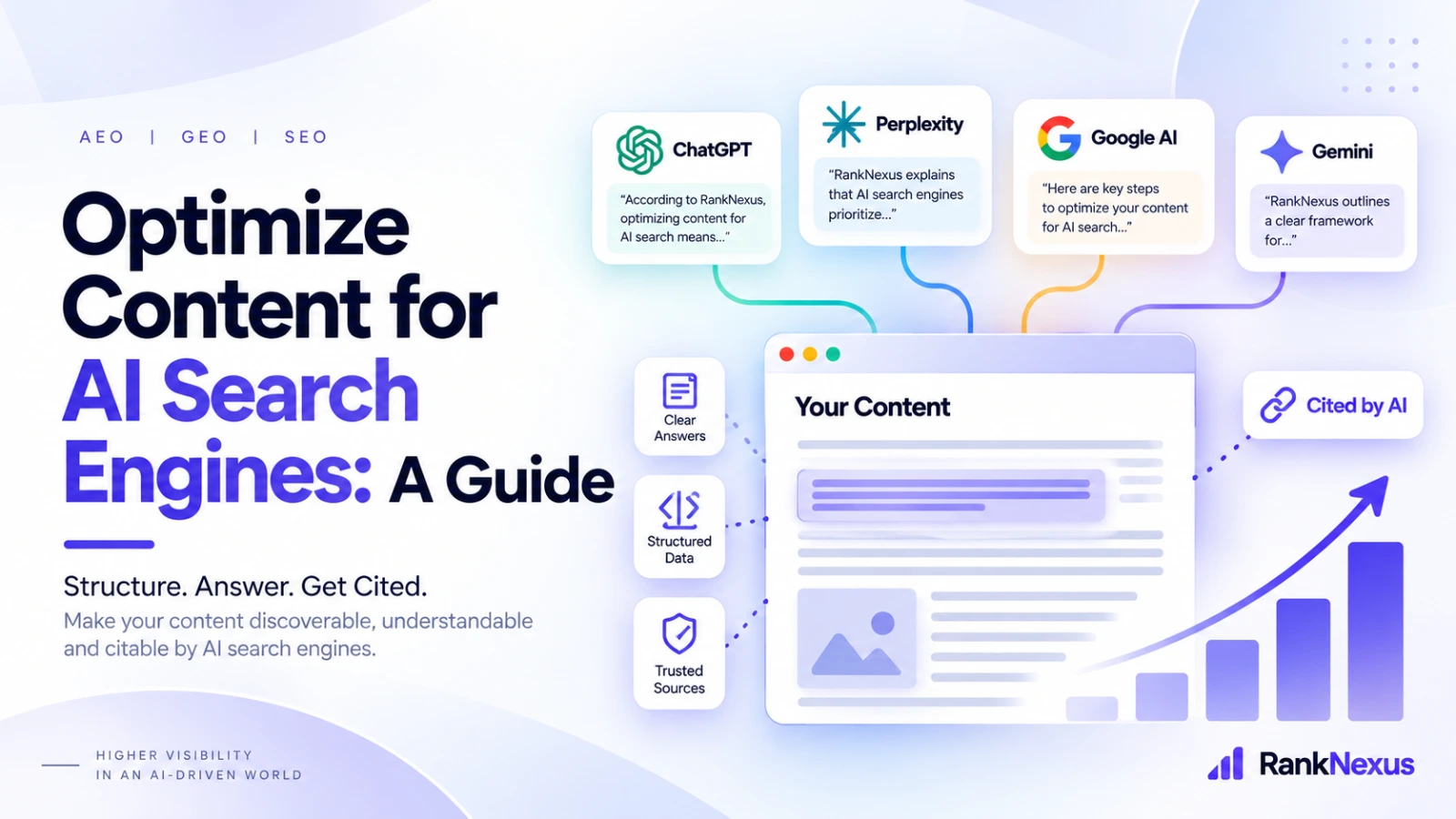
Optimize Content for AI Search Engines: A Guide
You published a solid guide. It ranks on page one of Google. And yet when you ask ChatGPT or Perplexity the exact question your article answers, your site is nowhere in the response. Some competitor you've never heard of gets quoted instead.
That gap is the new problem. Traditional search sends a user to your page. AI answer engines read your page, extract the answer, and show it inside their own interface—often without a click. If your content is not built to be lifted and cited, you lose visibility even when your ranking is fine.
Most articles on this topic stop at "write good content and add schema." That leaves you guessing what to actually change. This guide covers what it means to optimize content for AI search engines, how it differs from classic SEO, what you need before you start, what it costs, the exact steps in order, where people go wrong, and who should not bother yet.
What it means to optimize content for AI search engines
To optimize content for AI search engines means structuring your pages so that large language models like ChatGPT, Perplexity, Gemini, and Google AI Overviews can extract, trust, and cite your answers. You do this by writing self-contained factual sentences, covering a topic completely, marking up your data, and building third-party credibility the models understand.
Two terms describe this practice. Answer engine optimization (AEO) focuses on getting picked for direct answers and featured snippets. Generative engine optimization (GEO) focuses on getting cited inside AI-generated responses. Both push in the same direction: make your content easy for a machine to quote without needing the surrounding page.
How AI search optimization differs from traditional SEO
Classic SEO wins a ranking position. AI search optimization wins a citation inside an answer. The mechanics overlap but the goal changes what you prioritize.
Google ranks a page and the user clicks through. An AI engine reads dozens of pages, synthesizes one answer, and names a few sources. You want to be one of those sources.
The difference shows up in how you write and structure. Ranking rewards keyword coverage and links. Citation rewards clarity, verifiable facts, and a structure a model can parse in one pass.
| Factor | Traditional SEO | AI search optimization |
|---|---|---|
| Goal | Rank in the ten blue links | Get cited in the generated answer |
| Unit that wins | A page | A sentence or passage |
| Writing style | Keyword-led, full-featured | Answer-first, self-contained |
| Primary signal | Backlinks, on-page relevance | Clarity, structured data, third-party mentions |
| Success metric | Position and clicks | Citations and brand mentions in answers |
You don't throw away SEO. Strong technical health and backlinks still feed the models, because engines like Google AI Overviews draw heavily from pages that already rank. AI optimization sits on top of good SEO, not instead of it. Our methodology treats the two as one workflow rather than separate projects.
What you need before you start
Get four foundations in place before you optimize anything. Skipping these wastes effort, because AI engines ignore pages they cannot crawl or verify.
First, a crawlable site. If your content loads only after JavaScript runs or your robots.txt blocks bots, the engines never see it. Confirm your pages render server-side or are pre-rendered, and check crawl access with a technical SEO checker.
Second, an author and brand identity. Named authors, an about page, and consistent business details across your site and directories all feed the entity that AI systems build around your brand.
Third, genuine authority on your topic. AI engines cross-check claims across sources. If your page is the only place a claim appears and nothing supports it, you're less likely to be cited.
Fourth, a way to measure it. Test your target questions directly in ChatGPT and Perplexity and note who gets cited today. That's your baseline. A GEO readiness checker gives you a structured audit.
What it costs
AI search optimization costs mostly time, not money, if you already produce content. The paid tools are modest, and much of the work is rewriting what you have.
The real cost is editorial effort. Restructuring an existing article into an answer-first format takes a couple of focused hours per piece. Adding and checking schema takes another 20 to 30 minutes if you use a generator. New research-backed content that earns citations is the expensive part, because original data and clear authority are what models reward.
| Item | Typical cost in India | Notes |
|---|---|---|
| Rewriting a page answer-first | 2–3 hours of editor time | Biggest lever, lowest cash cost |
| Schema markup and checking | Free with tools, ~30 min | Product, FAQ, Article schema |
| SEO and GEO tooling | Often a few thousand rupees a month | Confirm current plans with the provider |
| Original research or data | Varies widely | Optional but strongest citation magnet |
Compare tool plans against what you actually need on our pricing and compare pages rather than buying the biggest bundle by default.
The steps to optimize content for AI search engines
Work through these in order. Each one raises the odds a model reads, trusts, and cites your page.
Step 1: Lead every section with a direct answer
Open each section by answering its own heading in the first sentence, in 40 to 60 words, with no preamble. Models extract these standalone passages. If your answer only makes sense after two paragraphs of setup, it cannot be lifted cleanly. Write the answer, then the evidence, then the nuance.
Step 2: Make sentences self-contained and quotable
Write facts that stand alone without the sentence before them. "UPI is India's real-time payment system run by NPCI" can be quoted anywhere. "This system, as mentioned above, handles it" cannot. Name the entity, state the fact, avoid pronouns that point backwards. This single habit does more for citations than any technical fix.
Step 3: Cover the topic completely, not thinly
Answer the main question and the follow-ups a reader asks next. Engines favor pages that resolve a query fully, so they don't have to stitch together three sources. Use a question explorer to find real follow-up questions, and build a logical content outline that covers them under clear headings.
Step 4: Add structured data
Mark up your content with schema so machines read it unambiguously. Use Article schema for guides, FAQ schema for question sections, and Product schema for commerce pages. Follow Google's official structured data guidelines, then check the output with a structured data checker so a typo doesn't void the whole block.
Step 5: Fix your headings and hierarchy
Use one H1, then a clean H2 to H3 structure that never skips a level. Phrase some headings as the exact question a user asks. Clear hierarchy tells a model where one idea ends and the next begins, making extraction accurate. Descriptive alt text on images helps too, and an image alt text generator speeds that up.
Step 6: Build third-party credibility
Earn mentions on sites and in datasets the models already trust. Citations in AI answers align with how often a claim appears across independent, reputable sources. Guest contributions, being quoted in trade press, and accurate listings all build the entity around your brand. A guest post finder helps you locate relevant outlets.
Step 7: Measure and re-test
Re-run your target questions in ChatGPT, Perplexity, and Google AI Overviews after your changes land. Track whether you now appear as a cited source. A GEO score analyzer turns this into a repeatable score so you can see movement over weeks rather than guessing.
A worked example
Say you run a 40-article blog for a Razorpay-integrated SaaS product, and your "how to set up UPI autopay" guide ranks fourth on Google but never appears in AI answers.
Start with the article's opening. It currently spends three paragraphs on background before defining UPI autopay. Move a clean 45-word definition to the top of the first section, naming NPCI and the e-mandate framework in the sentence itself. Split a wall-of-text "setup" section into H3 steps, each opening with the action.
Add FAQ schema to the eight questions at the bottom and check it. Pull three real follow-up questions from a question tool and answer them fully. Two weeks later, re-testing in Perplexity, your page now surfaces as a cited source for the autopay setup query. Nothing about your Google ranking changed. The structure did.
What goes wrong
Most failures come from four mistakes.
The first is content the bot cannot render. Client-side JavaScript that hides your main text means the engine sees an empty page. The second is invalid schema. A single malformed field can void the entire block, and people rarely check after editing. The third is thin, uncorroborated claims that no other source backs, which engines hesitate to repeat. The fourth is chasing AI citations while ignoring sound technical health, so the page never enters the candidate pool in the first place.
One more trap: writing for the machine so hard that humans bounce. If your bounce rate spikes and dwell time collapses, that feeds back into ranking, which feeds back into whether AI engines draw from you at all. Write for the reader first, structure for the machine second.
Who this is not for
AI search optimization is not worth prioritizing for every business right now. If your customers don't research through AI tools, your time is better spent elsewhere.
A hyper-local service with walk-in customers—say a neighborhood clinic—gains more from a strong Google Business Profile and local SEO than from AI citations. A brand-new site with no crawlable content and no authority should fix the fundamentals first. And if you have no capacity to maintain content, the ongoing re-testing this needs will lapse. In those cases, get traditional SEO working, then layer AI optimization on once you have pages worth citing.
Pre-flight checklist
- Your pages render for bots without JavaScript execution, confirmed by a crawl test.
- Each section opens with a direct, self-contained answer.
- Facts are written to stand alone, with no backward-pointing pronouns.
- Valid Article, FAQ, or Product schema is in place and checked after the last edit.
- Headings follow a clean H1 to H3 hierarchy with question-shaped H2s where natural.
- You have a baseline: you know who gets cited today for your target questions.
- Author, about page, and business details are consistent across the web.
Where Ranknexus fits in
If you'd rather not audit every page by hand, Ranknexus gives you the checks in one place. The GEO readiness checker and GEO score analyzer show where your content stands with AI engines, and the wider tools library handles schema, structure, and technical health. Start with a free readiness check, fix the biggest gaps first, and re-test in a fortnight. If you want a second pair of eyes on your setup, our team is on the contact page.
Want this done for your site?
Run a free audit and see exactly what to fix for Google and AI search.